Bottle Detected but Filling Does Not Start: Why?
The sensor light is on, but the machine will not fill. Trace the sensor signal, PLC input, clamp feedback and cycle permissives to find the waiting step.
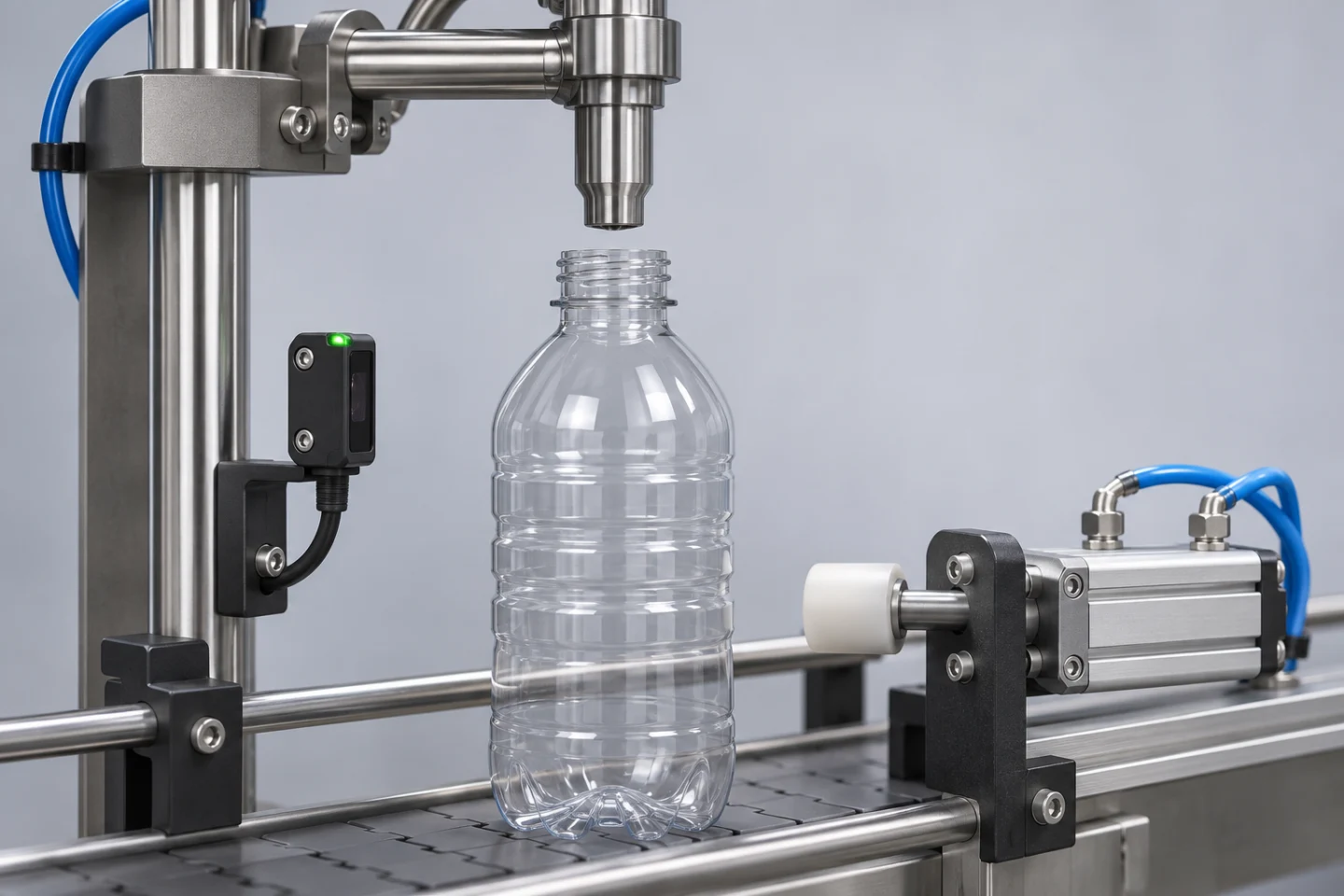
A sensor detecting a bottle does not mean the PLC has all the conditions required to start filling. The output must reach the correct PLC input, the program must interpret it correctly and the machine’s defined permissives must be satisfied.
The machine may still be waiting for clamp position, automatic mode, completion of the previous cycle or product availability. The sequences and status images here are conceptual, not live diagnostics from a specific machine. The generated cover is illustrative.
1. Separate the sensor indicator from the PLC input
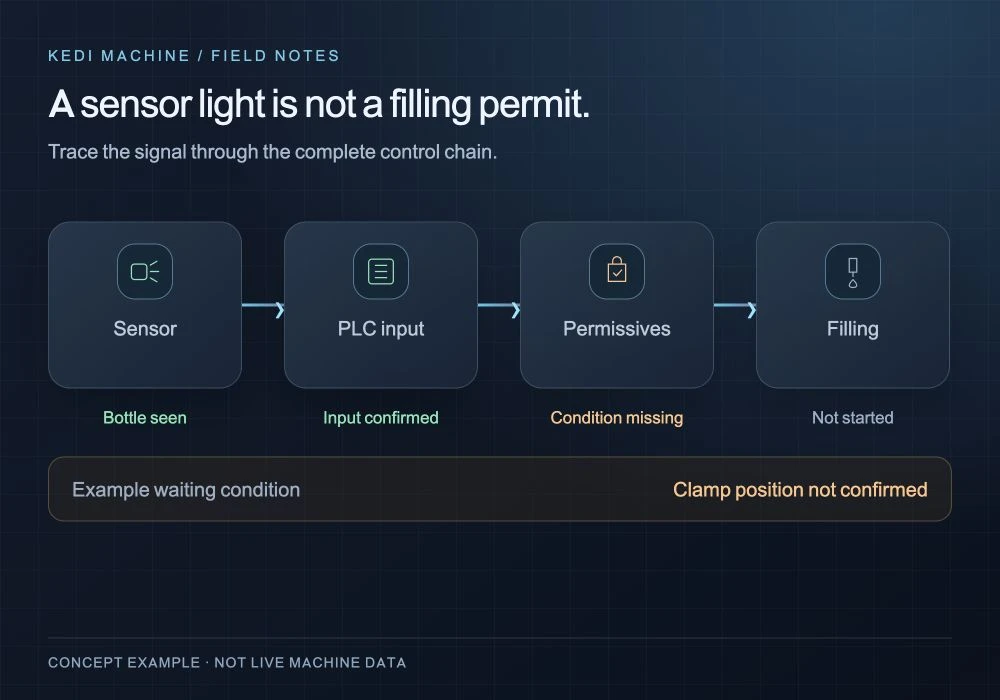
The key question is which PLC input actually changes when the bottle arrives? An LED may indicate power or switching status depending on the sensor model; those are different signals.
An authorised person can trace the following chain using the machine’s safe diagnostic procedure:
- Does the sensor respond to the bottle?
- Does its output match the required PNP/NPN or other interface?
- Are wiring and input common correct according to the diagrams?
- Does the correct physical PLC input change?
- Do the program and HMI monitor the same input information?
An HMI lamp can be misleading if mapped to another tag or displaying stale data after communication loss. The HMI–PLC communication guide helps distinguish these cases.
2. Is the bottle present but another permissive missing?
A machine may use some of the following conditions. This is not one mandatory program template for all equipment:
- Automatic mode and a start request
- Stable bottle presence at the filling position
- Confirmation of the required stopper or clamp position
- A suitable nozzle position if it moves
- Product supply ready
- Previous cycle complete and ready for a new cycle
- The required enable from the machine safety system
Find the first unmet condition. Showing the actual waiting reason is more useful than combining every condition into one “not ready” lamp. “Waiting for clamp closed feedback” gives a clearer diagnostic direction.
Do not bridge safety inputs, force PLC inputs/outputs or bypass guards to find a fault. Diagnosis and intervention must follow the machine’s safe working and energy-isolation procedures and be performed by authorised personnel.
3. Does a clamp command prove that it has closed?
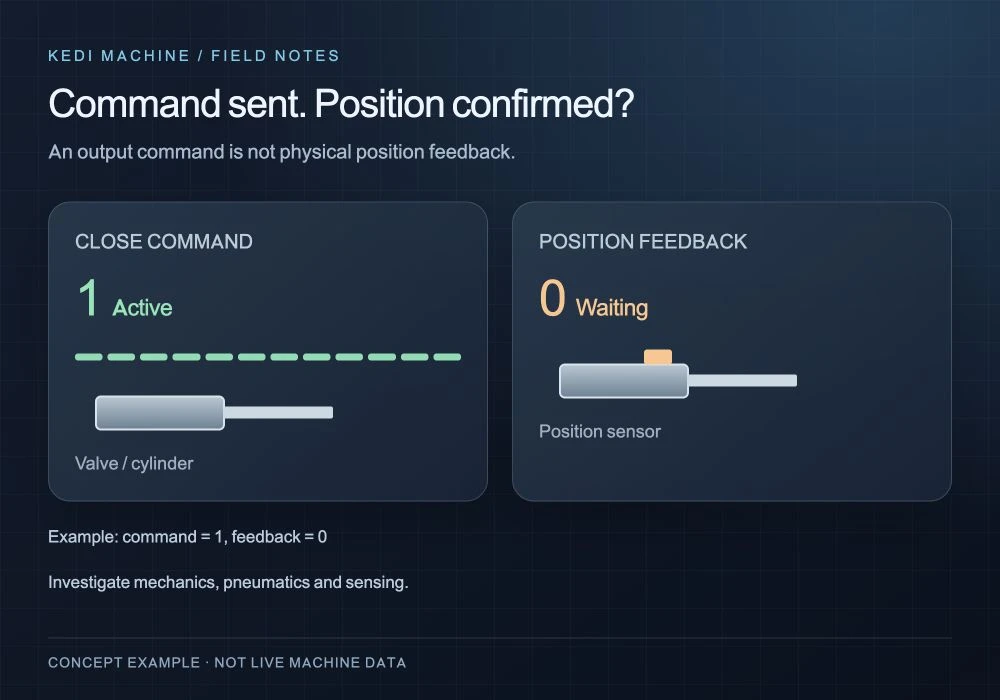
No. A PLC output to a valve and a cylinder reaching its required position are separate facts. Where a position sensor exists, verify that the expected feedback arrives.
If the close command is active but feedback is missing, the movement might not occur, the cylinder might not reach the position or the sensor/wiring might not report it correctly. The command alone does not identify which cause applies.
Supply pressure, valve behaviour and mechanical movement need assessment under the machine’s maintenance instructions, not an arbitrary pressure setting. If there is no position sensor, do not display an assumed position as confirmed feedback. A time-based step provides a different level of confirmation and must be defined accordingly.
4. Could the machine be in the wrong mode or previous cycle?
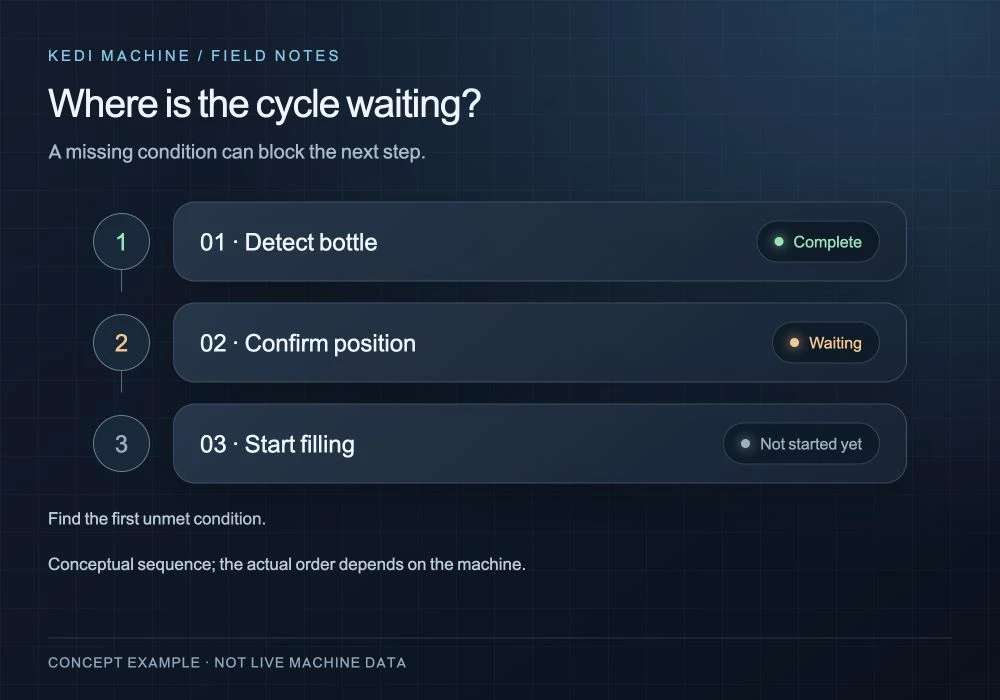
Bottle detection may not independently trigger a new cycle. The machine might be in manual mode, paused, waiting after completion or requiring a new start condition.
Some programs recognise a new bottle only after the input clears and becomes active again. A bottle remaining in front of the sensor does not create a new edge. Whether that behaviour is appropriate depends on the sequence; removing edge detection is not a universal remedy.
Recipe changes, a completed batch target or a stop request during the cycle may affect the next step. Define what Reset clears and whether a separate start request is required afterwards. Removing a fault must not cause an unexpected automatic restart.
5. What if the fill command is active but product does not flow?
Distinguish the PLC not entering the fill step from the PLC entering it without physical flow.
With an active command but no flow, investigate supply, pump, valve and nozzle path under their instructions. An HMI animation does not prove that a valve opened or liquid flowed. Without a suitable flow or measurement signal, do not assume that the program knows this directly.
If liquid flows but quantity is wrong, use the separate underfilling and overfilling guide to investigate quantity and flow variation.
6. Can clear bottles or vibration make detection unstable?
Yes. Sensor technology and application conditions matter. Consider bottle material, colour, label, sensing distance and background. Do not assume a conventional sensor will reliably detect transparent bottles.
A vibrating bottle or one at the detection boundary may cause the input to switch repeatedly. Review filtering and any stability delay against the actual signal and cycle requirements. Blindly adding delay can miss fast-moving bottles. Follow the chosen sensor’s model-specific setup or teach procedure.
What should be recorded?
- Machine mode and waiting message
- Sensor indication with and without a bottle
- The relevant PLC input and program tag
- Clamp/nozzle command and any position feedback
- Waiting cycle step and missing permissive
- Whether the problem follows every bottle, a pause or a product change
These records help separate detection, sequence logic and physical movement. Our HMI screen examples show useful operator information.
Frequently asked questions
Does a sensor light prove that wiring and the PLC input are correct?
No. Check the indicator’s meaning, output type, wiring and the actual change at the correct input together.
Why does Reset sometimes make it work?
Reset may change a defined wait state or cycle state. That does not prove the underlying cause is resolved. Record the missing condition and step before resetting.
What if the HMI shows a bottle but the PLC does not?
Check the HMI object’s tag, update status and communication. The indicator and real PLC input should represent the same source.
Technical references
- Banner Engineering: transparent bottle detection application
- ifm: pneumatic cylinder position sensing
These illustrate sensing principles. Use the current model manuals for the actual sensors and machine equipment when connecting or configuring them.